Some design study examples were all carried out and some implemented. The roses decrade allows perceiving zones of total accessibility between 0 and 8º and the areas of accessibility more conditioned. It also includes visual and tactile indications for the blind, luminescent for the deaf and routes with guidance systems for people with perceptive and cognitive difficulties.
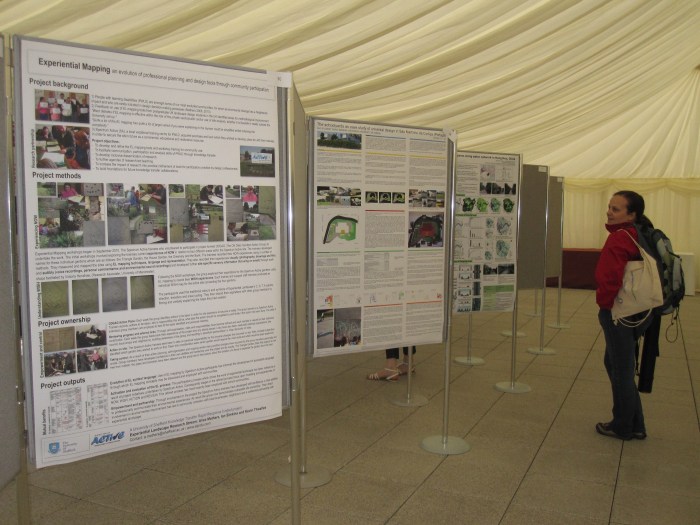
27 to 29th June(,) 2011: Public presentation of the theme “Schoolyards as a case study of universal design in São Martinho da Cortiça (Portugal)” at the International Conference in the Edimburgh University (Scotland) on the topic “ Research into inclusive Outdoor Environments for All“ carried out by Open Space, People Space (Web site: www.openspace.eca.ac.uk);

“Org: Technical University of Lisbon (Portugal)
Keywords: universal design, place identity, social identity, inclusive contexts, environmental education
Abstract: “Universal design means products and buildings that are accessible and usable by everyone, including people with disabilities.” (Steinfeld, 1994). This suggests that “designing special facilities for people (in this case children) with special needs is not necessary” (Fisman, 2001), and that the solution lies in the diversity of experience offered in spaces of school playgrounds. “Diversity in a schoolyard is an important element in promoting inclusion of children with special needs.” (Fisman, 2001). Based on the principles of universal design and a multidisciplinary approach including landscape architecture, environmental psychology and concrete experiences of design for children with special needs (i.e. cerebral palsy) a primary schoolyard, in São Martinho da Cortiça (Portugal) was designed. Planning this space aimed to meet specific human needs that research has shown to be affected in an informal manner in schoolyards: as the promotion of social interaction and cohesion, intra and intergenerational interaction, inclusive contexts (e.g., Patrício, 2002), restorative effect of nature (Kaplan and Kaplan, 1995), promoting place identity and social identity (e.g., Kim and Kaplan, 2004); or environmental education and pro-environmental behavior. This study reports on the different stages of the process (i.e. planning, construction and operation) in coping with the promoter’s interests and the performance of the area for the target-public. The main objective of the first stage was the design having in mind the users needs, and the second stage was a post-occupation by user’s, which covers both the perception and satisfaction of space as the assessment of its use. The main findings are related to the assessment of how the different users feel and use the outer space, on shortcomings found, on the positive and negative aspects of the promoter’s involvement in the various stages of the process. Finally findings of this experience may benefit future projects in other schools.”
OPEN SPACE INTERNATIONAL CONFERENCE (PDF)
Newspaper “O interior” opinion article achievement:
8th May (,)2008: entitled “Once upon a time”;
era uma vez … PDF
2007: “Alternative Formats” Sertec conference participation held in Porto Exponor Normédica and Ajutec Exhibition;
Newspaper “O interior” opinion article achievement:
3rd September (,) 2007: entitled “Back to adapted class”
regresso às aulas adaptadas PDF
16th August (,) 2007: entitled “The Fetish Step”
o fetiche do degrau PDF
5th July (,) 2007: entitled “Who is Disabled?”
quem é deficiente PDF
27th to 29th June (,) 2007: “Accessible Architecture” Forum participation held in Porto by the North Architects Order;
1st August (;) 2006: Celebration of Valhelhas river beach and camping requalification, to ensure accessibility for all after the destruction with the winter floods.
2006: Organization and public presentation in Manteigas of mechanisms that ensure accessibility in existing buildings without construction – (Held in Manteigas City Council);
2005 to 2006: Program “Cities and Villages Network with Mobility for All” applied to the Manteigas villa historic center, containing the following approaches: diagnosis of the quality and accessibility of historic center outdoor space; development an historical and urban morphology; conducting a landscape environmental analysis; development a social and economic environment study; diagnosis of outdoor spaces and its place names; survey of road circulations, removal architectural barriers and tree species used in street layout; development of a Mobility and Accessibility City Council Regulation; development of a requalification project to the streets “1.º de Maio” and “Dr. Sobral”; awareness-building activities with the children of the villa, built in the “alert school” program; awareness and presentation solutions with view to eliminating of architectural barriers;
2005: Delivery the final work, with the theme “Outdoor Space – Interdisciplinary Vision”, containing the following approaches: the importance of Landscape Architecture and Environmental Psychology in the preparation and evaluation of outer space projects; the importance of the outdoor spaces in the quality of life; sustainable outdoor spaces; inclusion and inclusive settings – universal design; general criteria and specific assessment and two case studies.
Done With file support of Pedro Batalha Lanscape Architect and Evora University Teacher, Fátima Bernardo Environmental Psychologist and Evora University Teacher and Victor Franco Psychologist, Evora University Teacher and Evora Director of Cerebral Palsy Portuguese Association (APPC);
March 2004: Arquitecturas magazine article published entitled “special spaces for special people in Montemor-o-Novo”;


17 th May (,) 2004: AJPsi – Youth Association of Psychology Congress Presentation under the theme “Experience (s) Space: Study of a case” held on in Evora University;
10st June (,) 2002: “The importance of Inclusive Settings and the special contribution of Landscape Architecture in these contextualized objectives” public presentation of inclusive settings used on the Community Partner Therapy Casa João Cidade project held on in Montemor-o-Novo (Évora);

 CarlaMarisaMadeira